10x100
Project
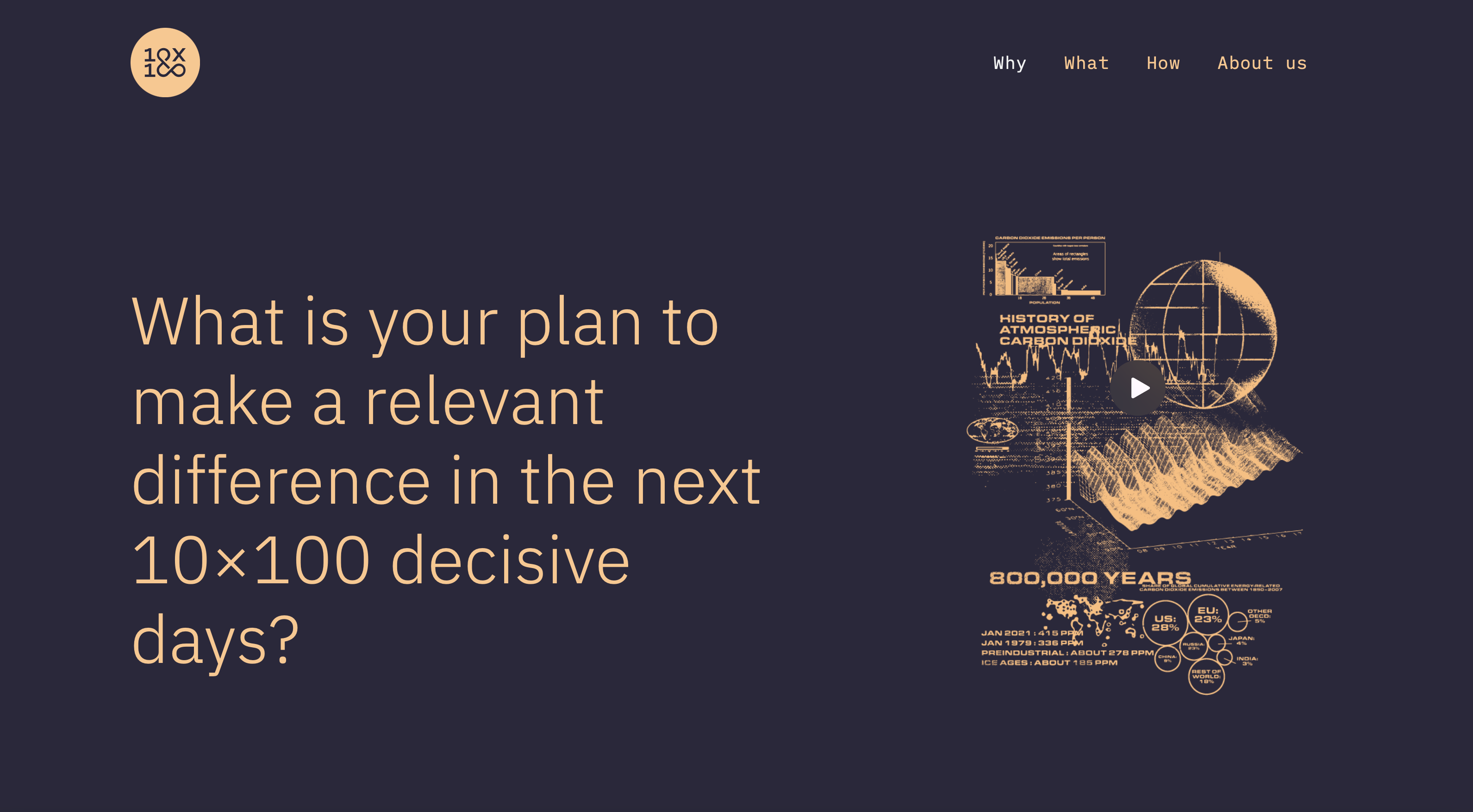
10x100 website designed by Politics for Tomorrow and Dark Matter Labs.
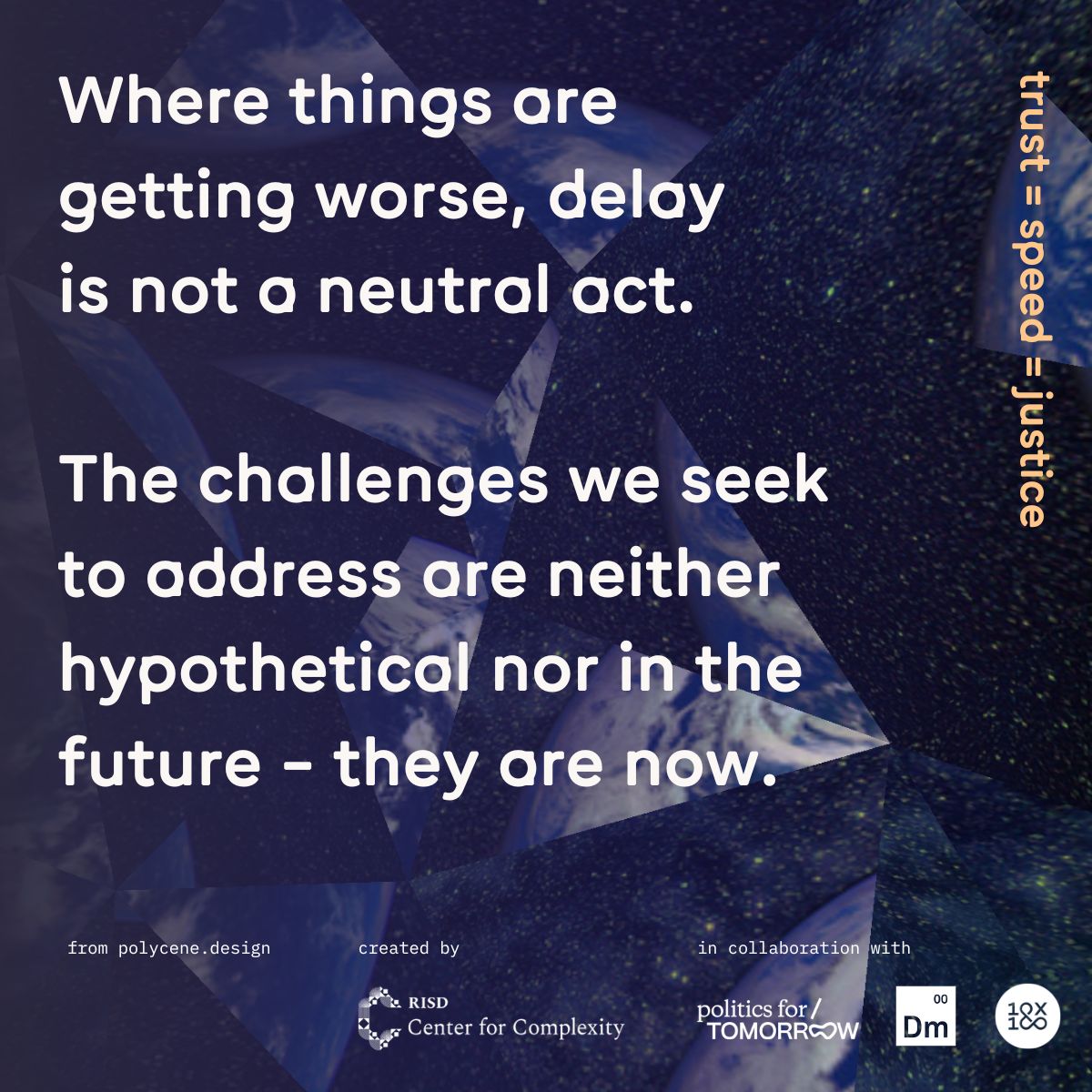
In an age of degenerative volatility – climate breakdown, institutional collapse, geopolitical fragmentation – the question of how we organise at scale has become existential.
Our inherited architectures (market coordination, state policy, firm-level control) are no longer capable of meeting polycentric, high-velocity complexity. The governance challenges of today can’t be met by 20th-century bureaucracies.
![]()
Our inherited architectures (market coordination, state policy, firm-level control) are no longer capable of meeting polycentric, high-velocity complexity. The governance challenges of today can’t be met by 20th-century bureaucracies.
About
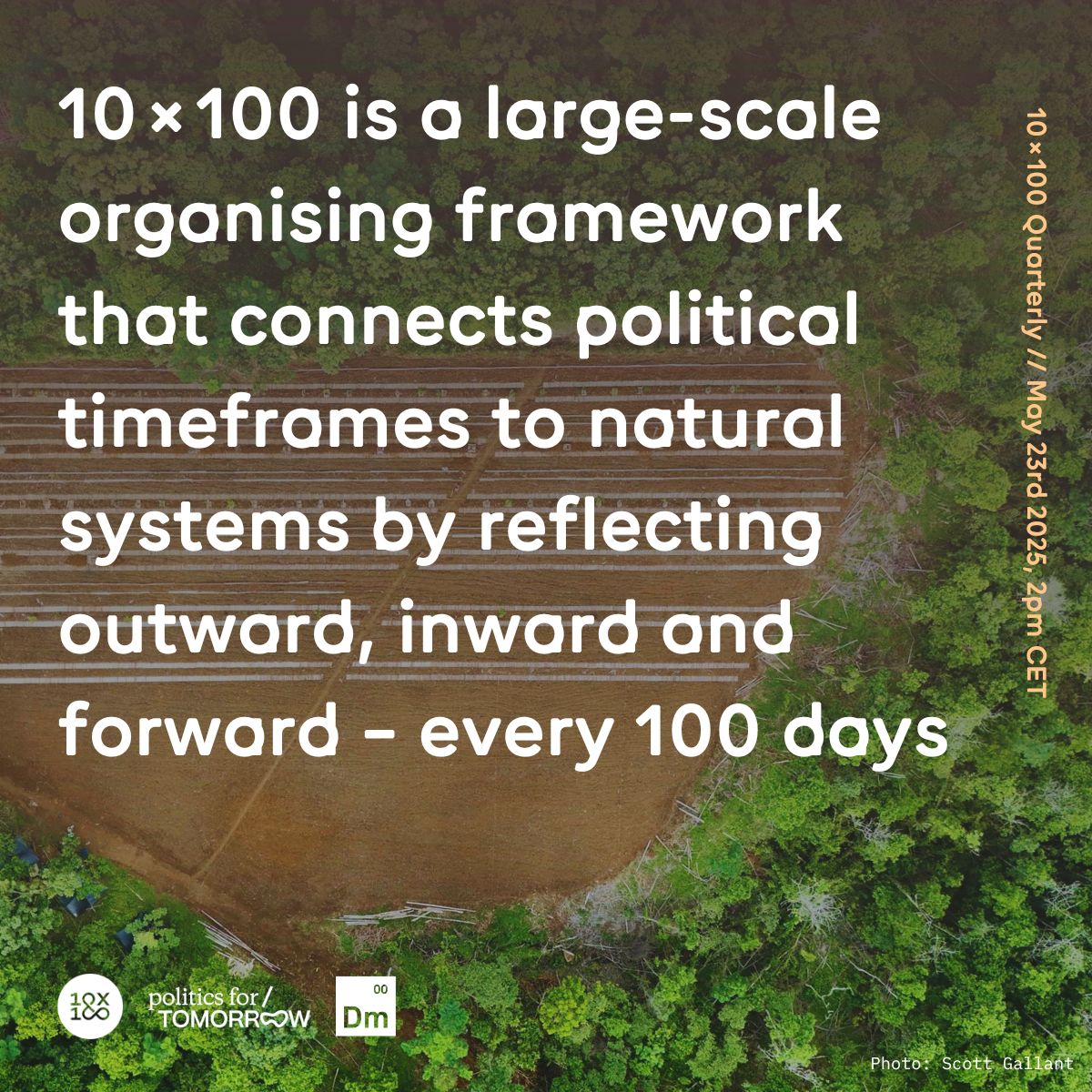
10x100 is a learning mechanism based on convening people every 100-days. The aim is to develop a pulse, a rhythm, and living infrastructure for change and coordination across varying scales. Started in 2022, the first cycle of 10x100 days ended in March 2025. The second cycle kicked off in August 2025 for another cycle of 10x100 days.
The current 10x100 provides an ultimate window of opportunity to transform human activity by design, instead of by disaster (IPCC, 2023). This scientifically backed timeframe has to be understood as a turning point for where our planetary society is heading and how we coordinate for systemic shifts.
Each day matters to adapt current policies for responding appropriately to the polycrisis and leverage practices that support each others, ending current path dependencies in order to move forward into a just and regenerative future.
The current 10x100 provides an ultimate window of opportunity to transform human activity by design, instead of by disaster (IPCC, 2023). This scientifically backed timeframe has to be understood as a turning point for where our planetary society is heading and how we coordinate for systemic shifts.
Each day matters to adapt current policies for responding appropriately to the polycrisis and leverage practices that support each others, ending current path dependencies in order to move forward into a just and regenerative future.
Substack Articles
Field Note: Engaging with Strategic Gaps
2×100 Quarterly Digest — December 28, 2025
When plans begin to loosen, it’s easy to interpret the moment as fatigue, ignorance or a commitment crisis: coalitions thinning, attention drifting, ambition fading. Inside the 10×100 Converter, another diagnosis keeps surfacing: what if the baseline conditions for collective coordination are shifting, and our established ways of working are not meeting the overlapping realities around us? This digest comes from that terrain.10×100 is woven together by a simple practice: people choosing, again and again, to gather. To slow down. To sit with one another – virtually and in person – and hold space for what usually gets rushed past: hard questions, grief, doubt, emerging clarity, real support. Gratitude keeps surfacing here, not as sentiment, but as a signal: a reminder that the desire to be together is still alive, even when the wider culture rewards speed, certainty, and performance.
The current Converter cohort assembles people who don’t necessarily share the same interests, beliefs, or institutional instincts. What brings us together is an inquiry: how does organising remain coherent when the ground shifts – across scales, mandates, and worldviews – without reverting to control, and without losing the ability to carry real weight?
This digest offers a way of making some patterns visible enough that we can keep weaving sense, trust, and direction across differences.
A Year in Motion
Each 100-day cycle carries its own momentum. We renewed the cadence in August 2025 with an in-person gathering at the European Forum Alpbach in the Austrian mountains, anchored in a core question: how do we organise across scales, sectors, and entities in a time when existing governance approaches feel less reliable or disappear?
In September, 1×100 opened the field online for those not in Alpbach. In late November, 2×100 became the first fully online Converter gathering – closing the year with a shared sense of acceleration, dissonance, and unexpected openings.
Instead of jumping into planning mode, we began with orientation: what 2025 left in its wake – in our work, our bodies, our relationships – and what that reveals about the changing baseline of coordination.
Naming Strategic Gaps
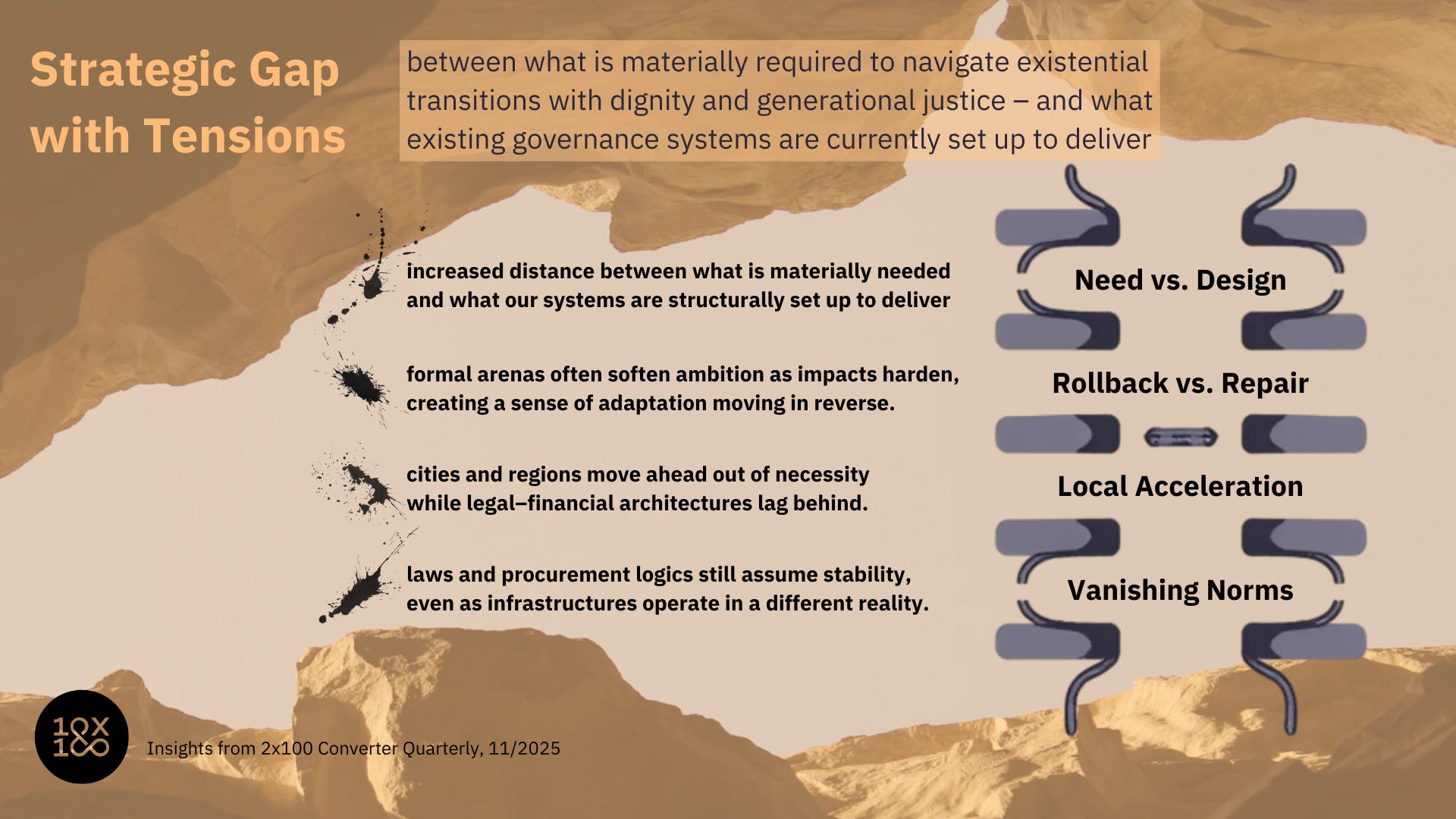
Across conversations, a common pattern became clearer: the distance between what is materially required for navigating existential transitions with dignity and generational justice – and what systems are currently set up to deliver is widening.
This gap was described through four tensions: Need and design drifting apart; repair losing ground to rollback; local acceleration outpacing legal-financial architectures; standards and procurement logics built for stability while infrastructures operate in a different reality.
Retrospective: Tuning Inwards
Our fielding practice started with noticing how large-world realities land in different small-world contexts. We worked with three questions and are curious how they resonate with you.
Where did 2025 touch you most deeply?
A quiet shift surfaced across reflections: from lone-wolf stamina toward bond-based capability. People spoke about finding a peer field and feeling something unlock – less “I carry this alone”, more “we have each other as infrastructure”. Integrity sharpened as a filter, changing where people invested their time. Collapse-awareness became more practical, reshaping decisions toward resilience and what can actually be stewarded.And there was unglamorous honesty: the comfort of familiar patterns, even when their limits are clear. Not a failure. A reminder of how the old world recruits us through ease.
Where did the gap widen or narrow?
Strategy-time keeps getting eaten first. The work that turns intention into delivery – stakeholder alignment, coalition craft, tactical planning – often gets squeezed. The gap between big words and consequential action appeared repeatedly. Different tempos created drag: constant “full stops” that turn alignment into friction. Several reflections described a drift from polycrisis toward metacrisis: solutions remain imaginable while conditions for holding and scaling them degrade.Underneath it all: engagement for the future is thinning. Enabling conditions are key e.g. stories that people can live inside, viable pathways that take shifts into account, economic models and legal frames that make participation easier.
What did you refuse to drop?
This question revealed bridge material: protecting the voices of those affected by systems change; keeping inclusivity alive in discourse; guarding time as infrastructure; staying loyal to relationship integrity; holding a stable spine of convenings, knowledge commons, and bioregional governance. There was also care for people and institutions that couldn’t move “forward”, staying in relationship without forcing pace.What landed: 2025 didn’t only accelerate crises but discernment about people, places, and practices that can carry reality without illusion. The strategic gap is a governance and coordination problem under stress – made worse when integrity, time, and permission are missing. When formal systems wobble, people protect the relational and temporal conditions in informal spaces that keep coordination possible.
Foresight: Sensing Outwards
From this inward terrain, we widened our perspectives. Without predicting or forecasting, people shared in smaller groups systemic pressure, fault lines, and occasional clearings that signal a shift:
Exhaustion and fragmentation intensifying alongside fast-forming alliances and local ingenuity – new coherence trying to form inside the gap. Nervous systems came into view as frontline infrastructure. Shock-load and fatigue are shaping attention and follow-through. Counter-moves already exist: micro-communities of trust; convening as creative practice (dinners, loneliness work); somatic and warm-data approaches; pleasure activism as an insistence on aliveness.
Movements are carrying wounds. The ecology of collective engagement hasn’t returned in the same way, and fragmentation runs through the field. Yet, new alliances appear between people who haven’t worked together before. The question shifts from unity to coherence: what holds without demanding sameness?
Local and bioregional organising continues to accelerate. Participants acknowledge their agency within reach – because traction often remains more available in bioregions, watersheds, and grounding organisation. Ecological language deepens, sometimes niche, sometimes spreading.
Finance is reorganising quietly and searching for connective tissue. Longer-horizon funding theses are emerging in some circles, paired with interest in capacity building and organisational readiness. Bioregional financing and accounting questions surfaced, including one provocation that stuck: the primary community asset is often the group, not the building; buildings multiply, community generates.
At the same time security framings are tightening the space for political imagination. The same pressure also opens a doorway for clearer stories about infrastructure, energy sovereignty, resilience – without letting “security” flatten justice.
One aspect surfaced with clarity: if climate engagement felt like it improved everyday life, more people would step in. Translation becomes part of the bridge – facts need to be embedded in dignity, wellbeing, safety, social benefit.
What sharpened: 2026 looks less like a year that rewards master plans, and more like a year that reveals the quality of our support structures – relational, narrative, financial, technological – the ones that allow real work to stay alive and developing when conditions keep shifting, increasing distraction and noise.
Priorities: Looking Forward
By the end of the sensing, “bridge” sounded less like metaphor and more like practical qualities: something nervous systems can cross; something that holds different tempos; something that translates contested terms into everyday life without shrinking meaning; something that keeps imagination available under pressure.
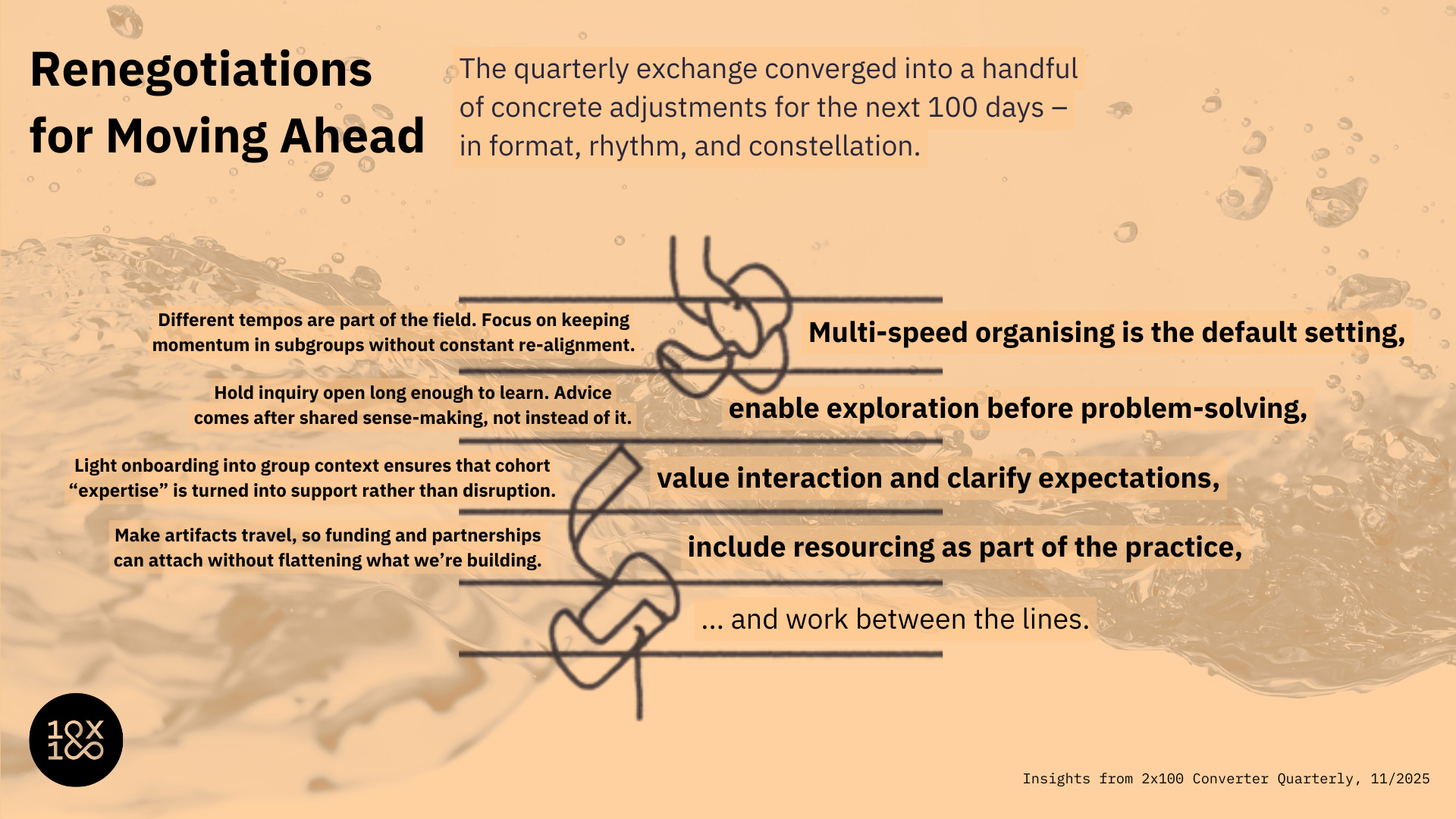
With the group work, we prioritised next steps: given this weather, what feels alive over the next 100 days, and what becomes negotiable in rhythm, format, constellation?
A few threads that carried energy with traction: hope as a practice of attention; local weaving as a coordination strategy; shared language as friction reduction; a shift from building a “framework” toward providing scaffolding people can populate; working “across scales” rather than focussing on large-scale organising alone.
A handful of near-term moves came into focus: naming the binding inquiry without forcing sameness; building a living lexicon and entry map; publishing a small set of sequences that travel; connecting subgroups through selective bridges rather than absorption; defining the discussed finance/accounting experiment clearly enough that it can teach the field something.
Learnings from the 2×100 Quarterly
Working in subgroups offered a clearer view of what the field is carrying in common, without smoothing over how differently the year landed.
The learning sits less in neat conclusions and more in a shared edge:
- Security framings test political and civic imagination. As narratives becomes more aggressive, imagination can either shrink into defensive realism or mature into something more precise: futures that remain livable within a landscape of exisitentila risks, without pretending they will be painless. What surfaced here wasn’t a single narrative, but a shared question about narrating honestly – without losing people to cynicism or purity spirals.
- Financial and legal pathways shape what can be multiplied without distortion. Existing architectures still tend to reward short cycles and extractive logic, even when intentions are collaborative. The forward energy in the room wasn’t abstract critique; it was interest in enabling architectures that can recognise civic capability (knowledge, relationships, governance capacity) as real value, not just overhead.
- Capacity becomes a field condition. Shock-load, trauma, and fragmentation are shaping the baseline of attention, trust, and follow-through. That shifts the nature of organising. It’s harder to rely on intensity as the engine. It becomes more relevant to work in “relay mode” that regulates pace, protects reflection, and keeps people healthy enough to engage mentally and emotionally.
- Tempo and translation show up as design questions. Many people are operating across different speeds and institutional logics while strategy-time keeps getting squeezed. The result is familiar: intention remains clear, delivery becomes harder to hold. Our research will focus on coordination approaches that can travel across contexts without requiring everyone to align on everything.
Moving across Shifting Baselines
A core element of the 100-day cadence is making commitments that can meet reality: small enough to test, meaningful enough to matter. The Converter is increasingly orienting around shared questions and enabling infrastructures. Yet the list of outputs is secondary. What’s most valuable is the strengthening of conditions for intergenerational efforts: clearer orientation, sturdier relationships, and practical forms that can travel across contexts without losing their integrity.
What keeps people in this work is an urgent commitment to aliveness – joy, agency, solidarity as stamina – and a desire to build bridges that don’t burn out their builders. It’s also the willingness to show up and “stay in relation” across uneven readiness, without letting difference dissolve our efforts into fragmentation.
Facing strategic gaps is unpleasant, and easier when done together. Fielding within and beyond these gaps has become an active practice of ongoing attention, care, and courage.
As we enter 2026, the work ahead is not only to build better systems, but to become better at holding one another while moving – or dancing – across shifting baselines.
This article was compiled by Caroline Paulick-Thiel and Toban Shadlyn, building on core material from the 10x100 Converter. This work was developed between November and December 2025, based on original content discussed in the 2x100 Quarterly.
Index